

Ronald C. Kessler: Shining Light on the Hidden Impact of Mental Disorders on People and Communities Everywhere
Ronald C. Kessler: Elucidating the population burden of mental disorders
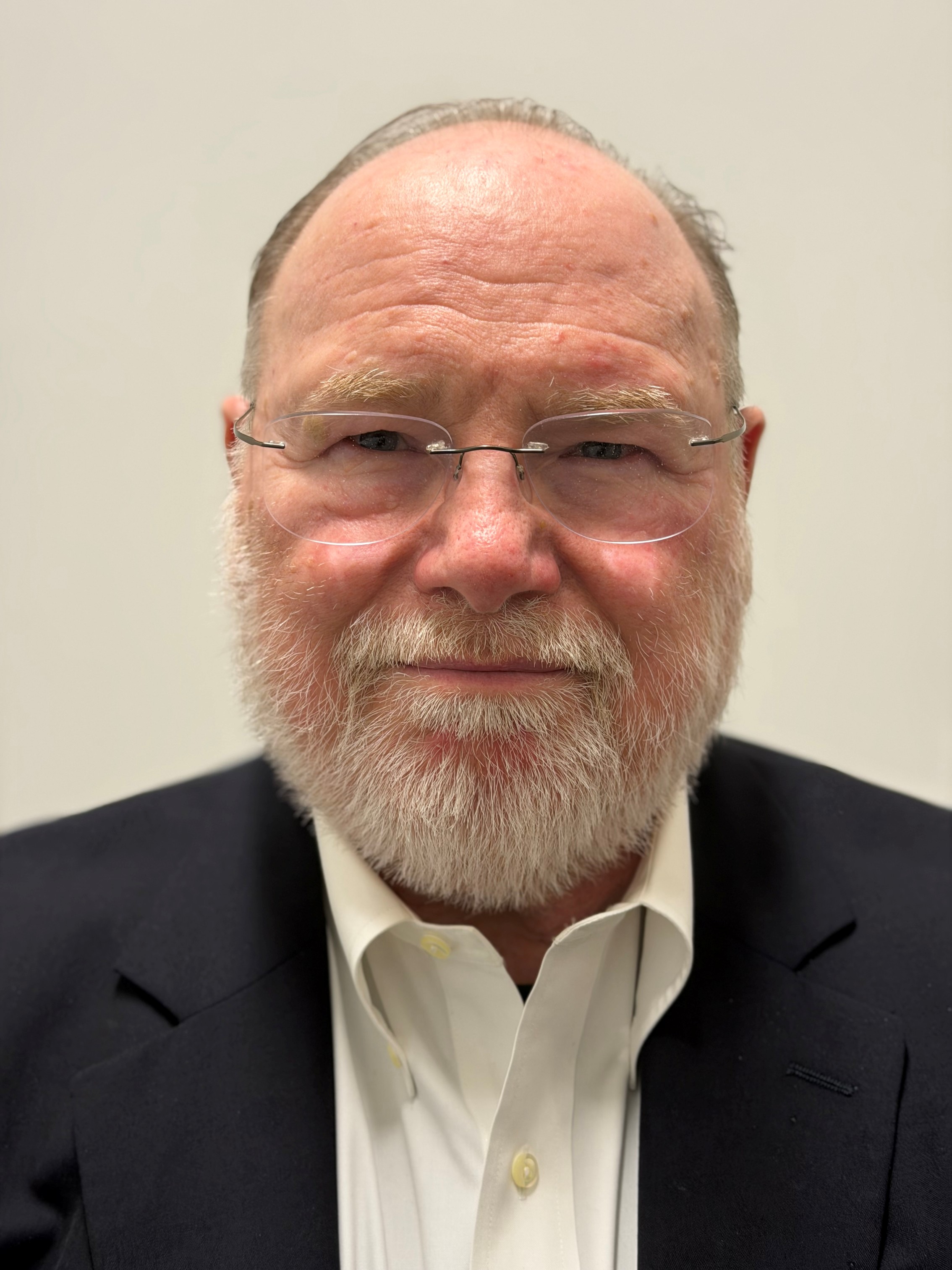
Ronald C. Kessler, PhD, Harvard Medical School, USA.
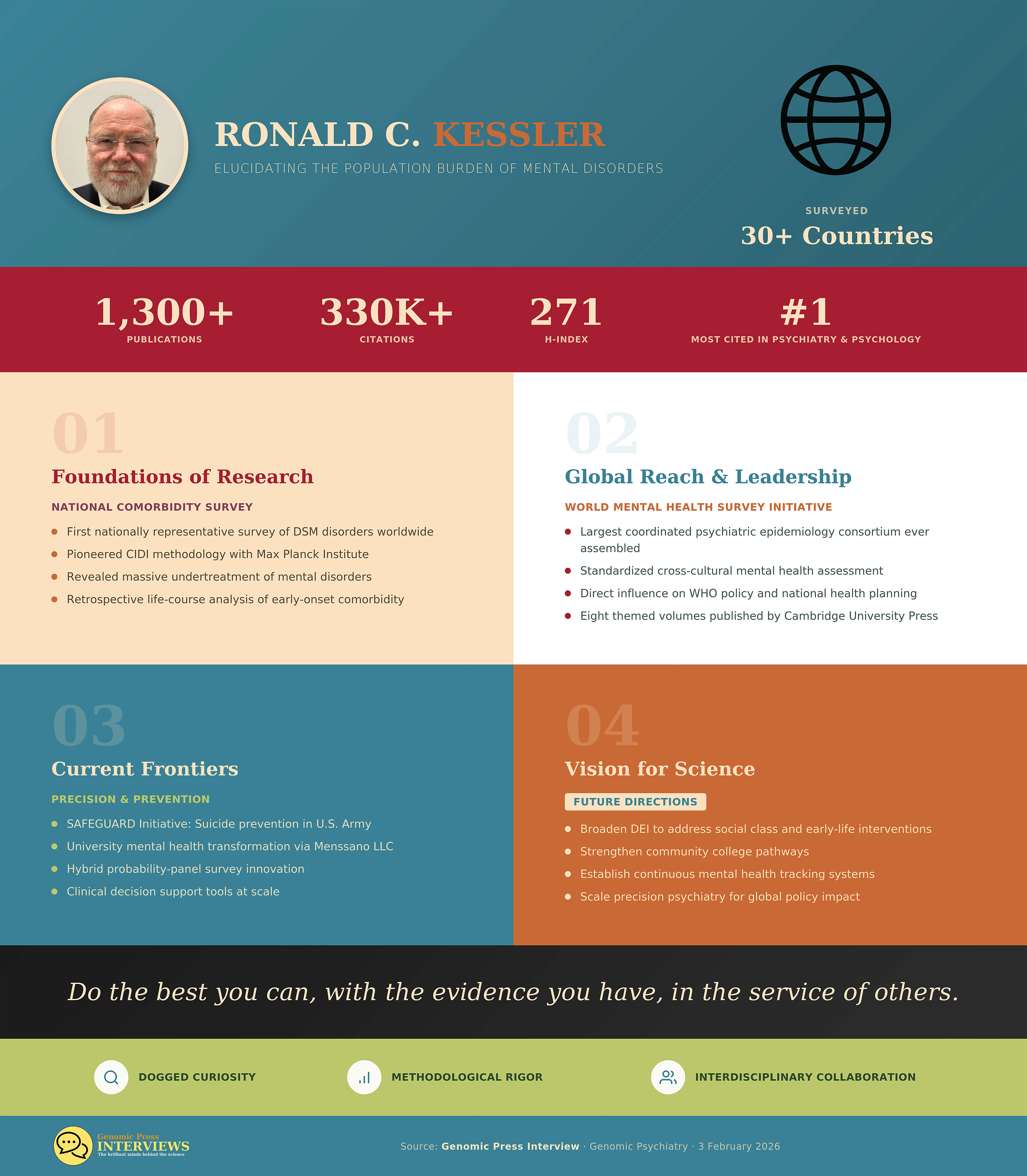
Ronald C Kessler: Impact on psychiatry and psychology
Landmark surveys across 30+ countries exposed massive treatment gaps, reshaping global mental health policy
Nothing in his early years pointed toward this career. A first-generation college student from a small Quaker community near Philadelphia, Dr. Kessler entered school planning to become a lawyer. A research methods professor noticed his analytical instincts and nudged him toward sociology instead, a pivot that eventually led to studying teenage drug use at the New York State Psychiatric Institute under Denise Kandel.
His three years at NBC television initially felt like a wrong turn. Working on a high-stakes study of whether violent programming harmed children, he learned to design research under deadline pressure with real money on the line. "We were required to put our ideas on the line in a way that would be quickly evaluated in the marketplace," he recalls, "a kind of rapid accountability that is rare in academia." What seemed like a detour became foundational training.
After a postdoctoral fellowship in psychiatric epidemiology at the University of Wisconsin, Dr. Kessler joined the University of Michigan as an Assistant Professor and faculty associate at the Institute for Social Research, the premier academic survey research organization in the United States. The Institute had conducted the first national survey on mental disorder prevalence back in 1957. Dr. Kessler eventually became Director of a new interdisciplinary training program in psychiatric epidemiology, laying groundwork for collaborative studies on unemployment and depression, HIV/AIDS, and aging.
In 1990, he was invited to join the MacArthur Foundation Research Network on Successful Midlife Development. "My good fortune to be invited into MIDMAC was probably the most pivotal event in my career," he reflects. The network brought together behavioral and medical scientists to study what enables adults to achieve good health during midlife. Dr. Kessler helped design and implement MIDUS (Midlife Development in the United States), a major national study that continues today, tracking how life experiences connect to health outcomes over time.
While that midlife study was still taking shape, another opportunity emerged. The National Institute of Mental Health sought proposals for a national survey modeled on the earlier Epidemiologic Catchment Area Program. Dr. Kessler won the grant based on his dual training in psychiatric epidemiology and survey methodology. The resulting National Comorbidity Survey became the first nationally representative assessment of DSM disorders in any country. Working with Dr. Uli Wittchen at the Max Planck Institute of Psychiatry in Munich, he adapted a diagnostic interview developed by the World Health Organization to track how mental health problems develop across a lifetime.
What the data showed was sobering: psychiatric conditions were far more widespread than previous estimates suggested, and the overwhelming majority of affected individuals received no care whatsoever. "The results allowed the field to see, for the first time, how early-onset disorders pile up and predict later problems," Dr. Kessler notes. These numbers became ammunition for advocates pushing insurance parity and increased funding, and helped establish new standards for psychiatric epidemiology worldwide. This interview exemplifies the kind of in-depth scientific conversation published by Genomic Press, which makes research freely available through open-access publishing.
As word spread about the American survey, researchers from other countries asked for help conducting similar studies in their own populations. Dr. Kessler enlisted survey methodologists to provide technical support. With encouragement from the World Health Organization, he established the World Mental Health Survey Initiative. Over two decades, this consortium grew into the largest coordinated effort to measure psychiatric conditions across different cultures ever attempted. Teams in more than 30 countries participated, producing over 1,000 published research papers and eight books through Cambridge University Press.
The German collaboration proved especially important. The diagnostic methods refined with the Max Planck Institute became the standard tool used across all participating countries, making it possible to compare mental health patterns from Brazil to Japan to Nigeria. Dr. Kessler moved to Harvard Medical School in 1996, where he continued directing data analysis for the global network while Michigan handled field operations. Earlier this year, he stepped down as Director, transferring leadership to longtime colleagues Bill Axinn and Stephanie Chardoul.
Asked what will outlast him, Dr. Kessler points to the consortium itself: "WMH not only helped establish a new global standard for population-based psychiatric epidemiologic research but also created opportunities for a generation of young investigators from around the world whose careers I would never have been able to influence had I followed a more conventional path."
These days, counting cases has given way to preventing them. One major project, SAFEGUARD (Suicide Avoidance Focused Enhanced Group Using Algorithm Risk Detection), tests algorithm-driven interventions to reduce suicide among U.S. Army soldiers. Another, developed through a company called Menssano with colleague Geoff Gill, delivers life-skills training to incoming college students and extends counseling capacity through digital tools.
He envisions a future where ongoing survey systems continuously track population mental health, allowing researchers and policymakers to spot problems early and measure whether interventions actually work. "I would like to help facilitate early evaluations to illustrate the value of such a tracking system," he says. "And I would also like to expand and institutionalize the continuous quality improvement system I am working on to monitor and intervene to improve the mental health of university students."
Three principles guide his research environment, Dr. Kessler explains. First, rigorous methods and intellectual honesty, always questioning assumptions and maintaining transparency about what the data can and cannot show. Second, interdisciplinary collaboration, recognizing that the best science happens when people with different expertise work together. Third, mentorship and inclusivity. "My own experiences made it clear that trajectories are shaped significantly by informal guidance and access to networks," he observes. "I now try to create a research environment in which students and colleagues are treated with respect, where diverse perspectives are actively sought, and where we are mindful of the real-world implications of our findings for the populations we study."
The interview also captures the person behind the publications. An avid squash player who hunts for antique furniture with his wife Vicki at New England auctions, Dr. Kessler names "dogged curiosity" as his defining trait. His most treasured possession is a grandfather clock made in his hometown of Bristol in 1770. "Clocks by this maker come on the market very rarely," he admits. "I paid more than I should have, but I could not help myself."
When asked about perfect happiness, he rejects the concept entirely. "Because of my work in mental health, I do not really think of 'perfect happiness' as a meaningful or even desirable goal. Sustained euphoria, after all, can be a symptom of illness. What I aspire to instead is a grounded form of well-being that includes feeling content, useful, and connected to others." He was happiest, he recalls, as a junior faculty member when his research portfolio was small enough to do most of the scientific work himself, "rather than, as later in my career, managing an extensive portfolio where I occasionally feel more like a foreman than a craftsman."
His greatest regret is letting professional demands crowd out being fully present with family. His greatest fear, having started his family later than most people, is dying before his children are firmly established in their lives. What is he most proud of? "My children." His greatest passion? "My wife." His heroes in real life: military service members. The historical figure he would most like to have dinner with: Dorothy Parker, "who was, by all accounts, an extraordinarily witty dining companion and keen observer of human nature."
Kessler's current state of mind: "Excited about technical innovations that I think will help improve the quality of psychosocial interventions to prevent and treat mental disorders, but worried about the politicization of science and uncertainties about the future of academic research." The motto that captures his philosophy: "Do the best you can, with the evidence you have, in the service of others."
Dr. Ronald C. Kessler's Genomic Press interview is part of a larger series called Innovators & Ideas that highlights the people behind today's most influential scientific breakthroughs. Each interview in the series offers a blend of cutting-edge research and personal reflections, providing readers with a comprehensive view of the scientists shaping the future. By combining a focus on professional achievements with personal insights, this interview style invites a richer narrative that both engages and educates readers. This format provides an ideal starting point for profiles that explore the scientist's impact on the field, while also touching on broader human themes. More information on the research leaders and rising stars featured in our Innovators & Ideas -- Genomic Press Interview series can be found on our interview website: https://interviews.genomicpress.com/
The Genomic Press Interview titled "Ronald C. Kessler: Elucidating the population burden of mental disorders" is freely available via Open Access, starting on 3 February 2026 in Genomic Psychiatry at the following hyperlink: https://doi.org/10.61373/gp026k.0021.
A high resolution summary of Dr. Kessler's life and career can be freely downloaded from this url: https://url.genomicpress.com/2zwndyph
About Genomic Psychiatry: Genomic Psychiatry: Advancing Science from Genes to Society (ISSN: 2997-2388, online and 2997-254X, print) represents a paradigm shift in genetics journals by interweaving advances in genomics and genetics with progress in all other areas of contemporary psychiatry. Genomic Psychiatry publishes peer-reviewed medical research articles of the highest quality from any area within the continuum that goes from genes and molecules to neuroscience, clinical psychiatry, and public health.
Visit the Genomic Press Virtual Library: https://issues.genomicpress.com/bookcase/gtvov/
Our full website is at: https://genomicpress.com/
Ma-Li Wong
Genomic Press
mali.wong@genomicpress.com
Visit us on social media:
X
LinkedIn
Bluesky
Instagram
Facebook
Legal Disclaimer:
EIN Presswire provides this news content "as is" without warranty of any kind. We do not accept any responsibility or liability for the accuracy, content, images, videos, licenses, completeness, legality, or reliability of the information contained in this article. If you have any complaints or copyright issues related to this article, kindly contact the author above.
